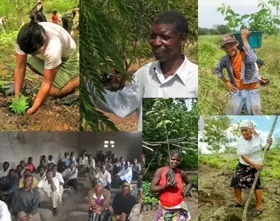

The mission of Carbon Offsets To Alleviate Poverty (COTAP) is to empower individuals and organizations in developed countries to address both climate change and global poverty. COTAP counteracts your carbon emissions through certified forestry projects in least-developed regions which create transparent, accountable, and life-changing earnings for rural farming communities where income levels are less than $2 per day.
The Problem
In developing regions around the world, hundreds of millions of people live in rural areas on less than $2 per day. This level of poverty forces communities to make hard choices between food, health care, and education. It is the poverty level where an estimated 11 million children die every year. Many of these communities are not fits for traditional microfinance, which tends to be primarily urban, and significant portions of their land are not suitable for agriculture.
While there are many promising technical innovations and development programs which can increase crop yields, there remains a geographic limitation on markets where such increased yields can be sold.
The result is that there are farming communities all over the world who could be made much less economically vulnerable if there were a way to generate significant supplemental income from non-crop land usage which did not rely on physical distribution.
The proven potential of small-scale forestry carbon projects
Small-scale afforestation, reforestation, and agro-forestry programs have a proven track record of reaching such communities and for creating direct, significant, verifiable and lasting economic benefits for them. One of the most compelling ways to finance such activities is through the sale of carbon credits.
Such projects have faced a combination of serious challenges in selling their carbon credits. Many would-be customers and/or project investors dispassionately view carbon credits as a single-dimension environmental commodity, of which they are only able to technically value and pay for the environmental component. Relative to other project types, carbon credits from community-focused tree planting projects credits are issued in smaller quantities, they are issued more slowly, and they entail a variety of unique risks, albeit highly manageable ones.
Further, carbon projects entail significant startup, certification, and ongoing management costs. In order to cover their costs and maximize returns, project investors rationally prefer larger projects and shy away from geographically-fragmented, small-scale ones where return/profit potential opportunities do not pool in large amounts in any one place. This, in turn, means that more carbon market volume is transacted under carbon standards which favor large projects, and that in turn puts more momentum behind the market acceptance of such standards, tilting the playing field away from quality, community-focused standards like Plan Vivo.
The small-scale forestry carbon financing gap
The above set of factors has created a financing gap for community-focused forestry carbon projects, whereby project organizers are able often able to obtain a fair per-tonne price, at an early stage, and at volume – but rarely, if ever, are they able to attain all of these factors at the same time. If this problem were solved, then the proven and multifaceted solution of small-scale forestry could rapidly expand, thereby lifting the poorest out of poverty, mitigating climate change, enhancing food security, and restoring landscapes at a much larger scale.
COTAP is founded on the belief that this financing gap, though understandable, is an unacceptable market failure – and a humanitarian injustice – given forestry carbon projects’ proven ability to reach and empower the world’s most vulnerable populations. Who does COTAP believe can fill this gap? Individuals and organizations in developed countries. Virtually all individuals in developed countries have unavoidable carbon footprints, and most are highly concerned about global warming, global poverty, or both.
The need for a crowdfunding intermediary
Every year, small-scale forestry projects plant trees which will result in the projected sequestration and long-term storage of tens of thousands of tonnes of CO2; however, the average annual individual CO2 footprint is relatively very small in comparison, CO2 footprints vary among individuals, and individuals have different preferences and budgets pertaining to how much of their footprint they wish to address.
COTAP is the critical intermediary which fills the gap between individuals and these poverty-alleviating projects by pooling together offset donations from many individuals and organizations and then working with projects to ensure that commensurate quantities of the offset they’ve generated will be retired, which means they cannot be re-sold.
The net effect is that, through COTAP, you’re indirectly employing the poorest people in the world to plant and maintain trees which counteract the emissions which you have not yet been able to eliminate. This empowers you to fight both climate change and poverty with one tax-deductible donation, and it empowers our participating farmers by connecting them with funding that’s at an early stage in the planting cycle, at a fair price, and at significant volume.
COTAP’s Solution
COTAP makes individuals in developed countries, primarily the U.S., aware of the poverty-alleviating power of forestry carbon projects, and COTAP makes forestry carbon credits accessible to individuals in small amounts and as a tax-deductible donation.
COTAP sources carbon offset funds from those who care about both climate change and poverty alleviation, pools those funds, and transparently matches those funds with our partners’ forestry projects in order to fill the forestry carbon finance gap, restore landscapes, and create direct, significant, verifiable, and lasting benefits for the most economically vulnerable people in the world.
All of COTAP’s current portfolio projects are registered under the Edinburgh, Scotland-based Plan Vivo carbon accounting standard. With roots stretching back to a research project in Chiapas, Mexico in 1994, Plan Vivo is the longest-standing and most established forestry carbon accounting standard in the world. Plan Vivo is also the only carbon accounting standard which always requires projects to have detailed plans for direct payments to smallholders and community groups. Plan Vivo-accredited projects are projected to sequester over 1.3 million tonnes of carbon dioxide.
Addressing more financing gaps by being “vintage agnostic”
COTAP not only seeks to support upcoming planting seasons at an early stage, but also supports projects’ unsold credits from prior planting seasons or “vintages.” In our view, unsold Plan Vivo credits are a societal injustice just the same as the fact that these projects’ credits aren’t pre-sold in larger quantities and at earlier stages. COTAP is thus “vintage agnostic,” so as to pursue all of our projects’ funding opportunities and thereby fulfill our mission to the fullest possible extent. As COTAP scales, the issue of older vintages will become a moot point as we will have been instrumental as the buyer which ensured those credits were sold. For more on vintages and COTAP’s transparency, please see COTAP.org/transparency.
More Accountable, Market-Based Philanthropy
COTAP’s dual mission, crowdfunding model, and tax-deductible status, together with Plan Vivo’s reach, accountability, and transparency, forms a new category of microfinance and a new category of high-performance philanthropy.
In pursuing its mission, COTAP doubles the number of reasons for individuals to take action on climate change and it greatly expands the climate change issue beyond that of a disempowering and single-dimension environmental problem.
COTAP’s Vision
On an annual basis, COTAP aims to eventually catalyze millions of tonnes of validated carbon sequestration, millions of planted trees, and tens of millions of dollars in wages to hundreds of smallholder farmers who live on less than $2 per day. Unlike “crowdsourced” philanthropic models which involve loans, grants, matched savings, or guarantees, COTAP involves wages.
COTAP creates a new system whereby the world’s most vulnerable perform the tangible service of counteracting the unavoidable carbon footprint of individuals in developed countries.
This will not be simple, easy, or quick, but this is one of the many things that is worth doing despite all of the challenges. It requires a movement, and we invite you to join us in our movement to make tomorrow brighter.